
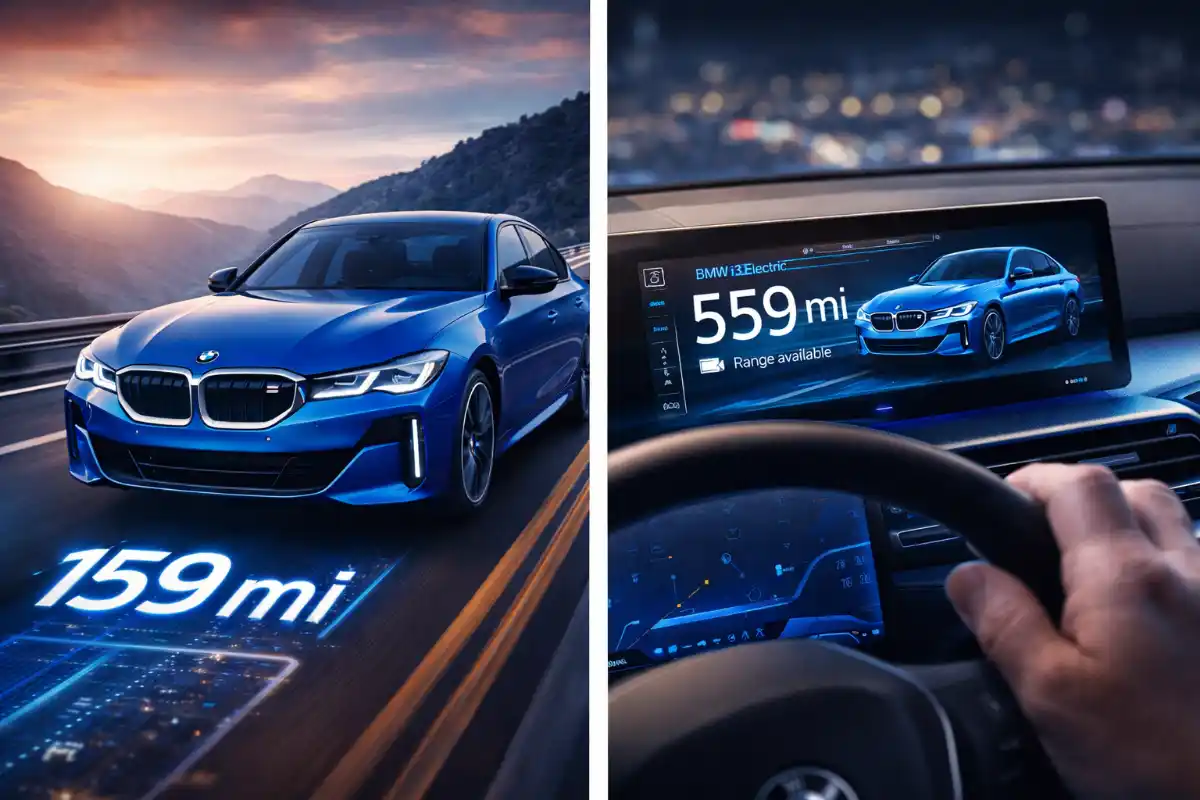
The new BMW i3 has been revealed and it is a game changer sporting a brand new design. For years, consumers faced a small, compact BMW i3, but now BMW leads the market with an all new, fully electric, i3 sports sedan, making it truly class competitive. This model also continues the redesign of BMW, classifying it as a part of „Neue Klasse,” and making it a highly anticipated electric model.
A major point of interest is the potential range of the BMW i3, at an astonishing 559 miles, however, reporters noted that range is based on estimations from the unrealistic Chinese testing cycle (CLTC), differing from more standard testing cycles used in the US (EPA), and therefore more realistic range estimates would likely be around 374 to 400 miles depending on version and market.
This remains a major concern when measuring the validity of the vehicle, however this remains a center point in the conversation around electric vehicles.
BMW has a lot to look forward to with launching the new electric 3 Series. They assure a fresh design with a more tech advanced interior and new features like a longer driving range and faster charging. To explain the importance of the new BMW i3 and the events leading to it, we will simplify the story.
BMW Announces New i3
The new BMW i3 has no resemblance whatsoever to the previous i3 hatchback. The old i3 was small, quirky, and intended for urban driving. This new version, however, is a full-sized electric sedan, comparable to the traditional 3 Series, and it will play a more significant role in BMW’s future.
The new i3 was built using their new EV platform, New Class. This is a new design for EVs and is built for optimum efficiency, faster charging, and more advanced smart design. This means BMW has been innovative and doesn’t simply slap an electric battery into an old petrol car design.
BMW values the new electric 3 Series highly due to the importance placed on it as one of the core models for the brand’s next generation.
Range of the New BMW i3
The range is the most significant part of the news article. New reports show the BMW i3 associated with a maximum figure of 559 miles. For a sporty sedan, that’s a massive number, and almost seems unbelievable. This is said to come from the CLTC cycle, which is known to have more optimistic figures than US EPA testing.
Because of the test, the number is real, however, buyers should adjust their expectations. For real-world scenarios, and particularly with the US market, the actual range is expected to be lower than 559 miles. In one report, the US EPA estimate of the i3 is around 374 miles for a high-spec version. Compared to 400 miles, BMW’s iX3 is compliant.
Nonetheless, i3 is highly competitive. The i3 is fitted with a battery pack of approximately 109 kWh and new high-density cylindrical cells, which should enable the sedan to serve long driving. This will offer considerable flexibility with charging stops.

Drivers would have a much easier time planning a road trip as well as keeping their commute as easy as possible.
A Significant Improvement with Fast Charging
BMW’s electric 3 Series provides an 800-volt system with a promising charging capability of 400 kW which would provide EV drivers with a more simple charging experience.
Upwards of 200 miles of range could be added in under 10 minutes of charging with the most optimal conditions with the potential BMW EVs.
This is very important because many potential EV drivers are concerned with the time it would take to charge an electric vehicle. BMW recognizes that it is important for EVs to charge quickly. To that end, the BMW i3 is designed to charge quickly, not just to have an abundance of range.
Performance Looks Strong Too
Unlike competitors in the segment, BMW is treating the i3 as something more than a boring eco sedan. Details indicate that the launch version will be an i3 50 xDrive, which is a dual-motor, all-wheel-drive version. Reports provide an estimated output of 463 to 469 hp and approximately 476 lb-ft of torque.
This range of output places the new BMW i3 in serious performance territory. It likely will not emotionally replace a full M car for everyone, but it is clear that it is not power deficient. Moreover, BMW is preparing an even sportier M3, EV, showing that BMW wants their electric future to remain exciting.
For normal drivers, this should provide an easy and smooth experience for everything from everyday driving to highway passing, joining traffic, and more.
Fresh Design Moves BMW in a New Direction
The look of the new electric 3 Series is generating buzz. BMW is implementing a new design language, derived from the Vision Neue Klasse concept, for the vehicle. While it maintains a few classic BMW design elements, such as the kidney grille, everything is more refined and futuristic.
This sedan has an extended wheelbase as well as a new modern front fascia. It is sporty in appearance and contrasts the petrol 3 Series, which shows how BMW wants the EV to be unique.
The interior is modern as well, Everything is reported to be a large central touchscreen, driving control interface, and a large panoramic dashboard display area. It looks like BMW wants to make the menu as simple as possible.

To some it may be a very strange car, but BMW has decided to make the new i3 unique.
Why the i3 Reveal is Significant
The new i3 shows BMW’s new design philosophy, battery tech, charging tech, and new battery tech. The new i3 is the first car from their new class era and is a premium EV, which means is a new class premium.
As such, the i3 has more room in the car, a lot more software to optimize driving, and most importantly the ability to accelerate and drive however it wants. It could drive off-road, go full sedan driving, and even go 100% electric.
The outcome may result in a vehicle that could facilitate the transition to an EV for conventional BMW customers.
Conclusion
The first impression for the brand-new electric 3 Series is notably positive. Granted, there is some more nuance needed to understand that the 559 miles of range is from CLTC testing, reporting a higher range than the more demanding EPA testing. Nonetheless, the BMW i3 still gives the impression that it is meeting the needs of most EV purchasers which is large range, fast charging, contemporary design, high-performance.
With the launch of the BMW i3, it is evident that BMW is taking risks, as it is not a vehicle being designed to merely ‘fill the gap’ in the range, but rather, represents a real statement of intent from BMW to show what it envisions for the future of electric vehicles. If, as rumored, the real-world performance is as expected, then this has the potential to be, for BMW, one of the most significant EV launches it has had for a considerable time.
The newest addition to the BMW i3 family is a lot more than a new name. It is going to be the vehicle that will make premium electric mobility simplified, practical, and most importantly, will add a lot more excitement to the experience.
