
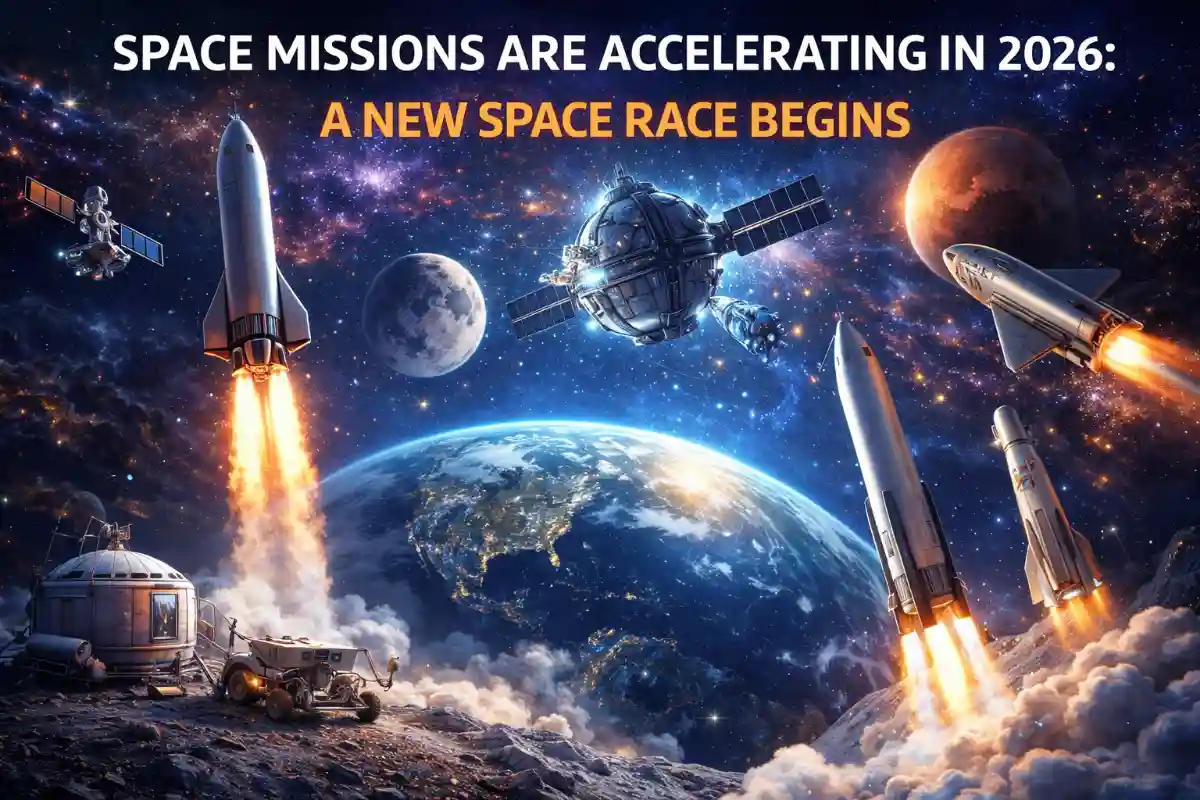
Modern space exploration is ramping up quickly and 2026 is going to be one of the most exciting years by far. Hopes of returning to the Moon, establishing Moon bases, and planning a human mission to Mars are now becoming realistic. Both government agencies and the private industry are actively preparing for a human presence beyond Earth.
The Buzz Around the NASA Artemis Program
The current leader of this new space age is NASA with its Artemis program and Moon to Mars plans, aiming to establish a sustainable human presence on the Moon. In 2026, Artemis II will take place, marking the first crewed mission to the Moon in over 50 years. This mission will test critical systems and life support technologies. Following this, Artemis III aims to land humans on the Moon again, paving the way for future exploration. This marks the first real step in humanity’s journey beyond Earth.
Building the Moon Base: From Exploration to Colonization
For the first time, the goal is not just to visit the Moon but to build a long-term lunar base with international collaboration. This base will support a long-term human presence, act as a research facility, and serve as a launch point for Mars missions. Engineers are already working on habitats, power systems, and life support technologies. Soon, the Moon could become the first place humans live beyond Earth.
SpaceX and the Rise of Private Space Power
A major shift in 2026 is the rise of private companies, led by Elon Musk’s SpaceX. The company is developing the Starship rocket, designed to carry humans and cargo to the Moon and eventually Mars. This system is expected to be more cost-effective than traditional rockets. The collaboration between governments and private companies is accelerating innovation and enabling more frequent travel. Government-only control of travel is coming to an end.
The Space Race Commences
The global space race is intensifying, with many countries investing heavily. China aims for crewed Moon missions by 2030, Japan is developing lunar landers and robots, and Europe continues to collaborate on projects. Other nations are also launching satellites. This mix of competition and collaboration is driving rapid advancements in technology and setting ambitious goals.

The Human Challenge: Can We Live in Space?
Sending humans into space is not easy, especially for long durations. Challenges include muscle loss in microgravity, bone density reduction, psychological isolation, and even studies on human reproduction. Before humans can settle on the Moon or Mars, we must learn how to survive and adapt in space environments.
What Will Come Next?
The future of travel is becoming more ambitious. Plans include frequent crewed lunar missions, lunar outposts within the next decade, missions to Mars, and next-generation propulsion systems like nuclear technology. Each step brings humanity closer to becoming a multi-planet species.
Why is this topic going viral?
Exploration is trending globally due to its connection with advanced technology, human exploration beyond Earth, the search for life, and the role of AI and private companies. Popular searches include “2026 Artemis II mission” and “Moon base plans.” This explains why space news is dominating online platforms.
Final Thoughts
The space missions planned for 2026 will not only accelerate progress but also redefine humanity’s approach to space. With NASA missions and rapid development in propulsion systems, the race to explore space is intensifying globally.
We are entering a new golden age of exploration, where humanity could transition from an Earth-bound civilization to a multi-planetary one within the next decade.

Conclusion
The excitement around exploration in 2026 is real. With Moon missions, Mars ambitions, and rapid technological progress, what once seemed impossible is now achievable. Space missions are increasing, and the future is clear
The future of humanity is not limited to Earth.
