
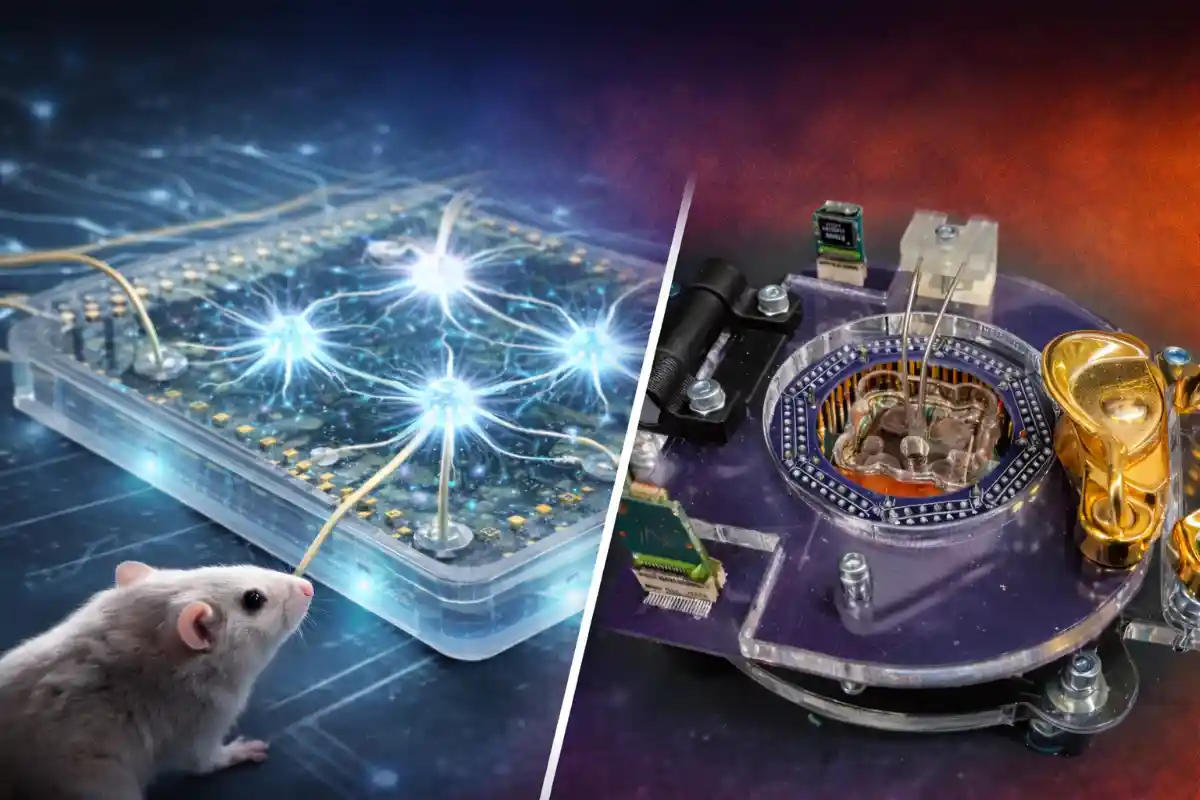
Creating living rat brain cells into a computer-like process. This brought a new way of merging biology and technology. This news has sparked new ways of thinking in technology.
Don’t worry, even if you don’t have a scientific background, we will explain everything.
There are many ethical concerns, but we will cover everything.
Scientists just transformed living rat brain cells into a computer, plain and simple.
Scientists just transformed living rat brain cells into a computer, plain and simple.
Researchers have proven that living rat brain cells can perform computer tasks. This isn’t a normal computer. It lacks silicon chips like other devices.
This computer uses real neurons. After being extracted from living rat brain tissue, real neurons are maintained in a laboratory and interfaced with a microelectrode system.
This system allows brain cells to communicate, and in a simple way, the neurons use microprocessors.
This system is a new kind of computer system and is sometimes referred to as a biological computer.
What is It That Scientists Created?
The brain cells are developed in a lab in a controlled way. The cells are placed in a chip. Scientists use it so that they can send messages to the neurons.
The neurons respond to the messages. They learn the patterns that are sent to them.
This means that the brain cells can learn to respond to the stimuli. Other computers do not respond to stimuli.
Simply put:
A normal computer has a set of instructions it has to follow.
This system can learn and adjust.
That makes it both powerful and very different.
How Does This Brain Cell Computer Work?
The process may sound complex. But we will try to keep it simple. Scientists grow rat brain cells in a lab. The cells are placed on a special chip. Electricity is sent to the cells. The cells respond to the electricity and form patterns. They eventually learn tasks. This “learning’ ability is what makes the system more flexible. The whole setup is designed to be easy to test and study in controlled conditions.
What Makes This Discovery Important?
This breakthrough could change many things.
1. New Type of Computing
Traditional computers can not learn. This system can learn. That makes it special.
2. Energy Efficiency
Brain cells use very little energy. They can be more efficient than traditional computers.
3. Better AI Systems
Brain cell computers could help machines think in a more human way.

The core principle is straightforward: integrating biology and technology.
Real-World Applications
Although this technology is still in its infancy, the experts envision multiple possibilities.
Medical Research
Brain behavior can be analyzed with simplicity and efficiency.
AI Development
Brain-inspired systems are likely to be intelligence augmented.
Robotics
Instead of programming, Machines can be taught to perform tasks naturally.
Drug Testing
Brain cell testing can lead to more reliable methods.
The potential of this system is evident in the streamlining of research that will be possible.
Ethical Concerns and Questions
The excitement is justified, but it invites additional questions.
Is It Ethical?
The use of live cells is controversial.
Could It Become Conscious?
Concern over potential awareness is unwarranted, according to experts.
How Far Should We Go?
Yes, undeniably. Restriction is essential.
Though risk is an issue, the questions are of paramount importance and should be articulated clearly.
Challenges Scientists Still Face
The technology is still in its infancy.
Stability Issues
The viability of brain cells is essential to their proper functioning. This is a growing concern.
Scaling Problems
The approach has remarkable potential, but it is currently a limitation.
Control Limitations
The behavior of neurons is beyond the control of modern science.
The potential seems limitless, but many challenges remain.
How This Compares to Traditional Computers
We can look at both systems quite simply like this:
| Feature | Traditional Computer | Brain Cell Computer |
|---|---|---|
| Structure | Silicon Chips | Living Neurons |
| Learning | Limited | Adaptive |
| Energy Use | High | Low |
| Flexibility | Fixed | Dynamic |
The comparison shows why the new system is needed.
It provides an easier route towards advanced computing.

Future Possibilities
The possibilities of the future of this technology is extremely exciting.
Scientists think this may lead to:
Hybrid computers (bio + digital)
More intelligent AI systems
A better understanding of the human brain
If it is developed correctly, this could make computing more simple and natural. Although, it will take many years of researching.
What This Means for Everyday People
How does this affect you? Currently, it does not have an impact on your daily life. However, it will in future:
- Devices could become smarter
- Technology could become more efficient
- AI could feel more natural
Ultimately, all of this aims to make technology more easy and simple for users.
Final Thoughts
The news Scientists Just Turned Living Rat Brain Cells into a Computer is both exciting and surprising.
It shows how far science has come. It also shows how much more is possible.
This unprecedented breakthrough intertwining biology and technology, may well shape the future of computing.
At the same time, it raises important questions. These must be handled carefully.
Conclusion
To summarize, Scientists Just Turned Living Rat Brain Cells into a Computer, and this may change the tech world as we know it.
Biological computing opens new avenues
Biological computing facilitates learning and adaption
Biological computing enables new possibilities for future breakthroughs
The idea may seem confusing, but with the right approach, it can be easily communicated.
Biological computing is in its infancy. There is still a lot to be done.
