
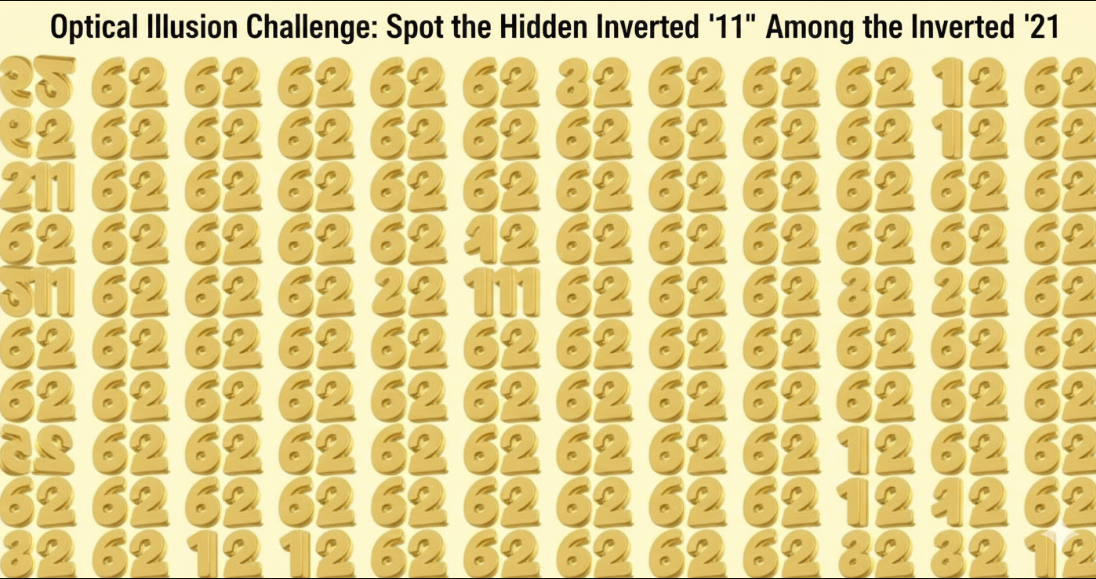
The newest Optical Illusion Challenge in the news features a grid of upside-down “64”s. Among the numbers, there is one upside-down “14” that appears every so often. The goal is to find the “14” in a limited amount of time.
According to news reports, most people do not succeed on their first try because the brain makes a quick assumption that every number is the same. This is what makes the illusion easy to grasp and quick to try, but frustrating to solve.
The popularity of these challenges stems from the fact that they demonstrate the way the brain perceives images, while also challenging the viewer’s ability to see.
How Optical Illusion Challenge Trick the Brain
Challenging Optical Illusion Challenge play on the brain’s tendency to recognize the same thing a lot. People’s brains prioritize speed and will often group similar images without stopping to examine each one closely.
In this case, the upside-down “64”s are all very similar. The upside-down ‘14’ fits in and does not draw attention because at a glance, its shape will not stand out. This is what makes the challenge easy but not simple, as the brain has to slow down in order to recognize the differences.
Psychologists rely on optical illusions for research on attention, perception, and visual memory, which gives more importance to these puzzles than entertainment value.
How Come the Optical Illusion Challenge Is So Popular?
Reports show that participants in the Optical Illusion Challenge appreciate:
- It is very understandable
- It employs basic numerals instead of elaborate graphics
- It tests focus and concentration
- It evokes interest and rivalry
Because it is simple and quick, people share it with others and see who can solve it first.
How to Find the Inverted ‘14’

Don’t worry if you’re finding this Optical Illusion Challenge difficult; these 3 easy tips might help.
1. Watch the Shapes, Not the Movement
Again, no need to rush; study every number individually. In ‘14,’ the ‘1’ is clearly a straight line, whereas the ‘6’ in ‘64’ is curved.
2. Watch the Picture in Sections
This is pretty simple, and it helps a lot to prevent your eye from skipping over important details.
3. A Moment of Rest Helps
You know your eyes are sensitive, and so is the Optical Illusion Challenge, so looking away for a few seconds can help reset the challenge and may make it easier to see the hidden number.
4. Change How You Look at It
It helps to step back or look from a different angle. This can help you see the detail that you were previously missing.
Benefits of Solving Optical Illusions
Not only are these challenges fun, but there are also additional mental benefits that come with them.
- Improved focus
- Improved problem-solving
- Increased mental flexibility
- Decreased stress
Due to the simplicity of these challenges, people of all ages can participate.
Optical Illusion Challenge FAQ
Q1: How does an Optical Illusion Challenge work?
An Optical Illusion Challenge works because it causes people’s brains to misread what they are seeing. From months or years of experience, the brain gravitates towards a certain answer because of previous patterns.
Q2: Why do these look easy?
The image looks familiar to people, so they assume they can solve it quickly. The brain finds shortcuts to solve the image.

Q3: Can I get better at solving Optical Illusions?
Over time, your brain will get better at identifying differences with regular practice.
Q4: Are Optical Illusions good for the brain?
Yes, they are great for your brain. They keep your brain focused, mentally active, and improve mental flexibility.
Q5: How much time do you think it will take to complete this challenge?
There is no specific time that can be given. Some take a few seconds to complete it, while for some it takes a few minutes. Both of these durations are completely normal.
Conclusion
The viral Optical Illusion Challenge, which asks viewers to spot the hidden inverted “14” among inverted “64” numbers, demonstrates that appearances can be deceiving. The puzzle may look easy, but it is not easy for the brain to process.
Making these challenges part of your free time not only helps you take a break but also improves your perception and focus. The time taken to solve the challenge is not as important as the experience.
Next time you see an Optical Illusion Challenge, you should try it. With a little patience, you might even be surprised at what you and your brain can find.
