
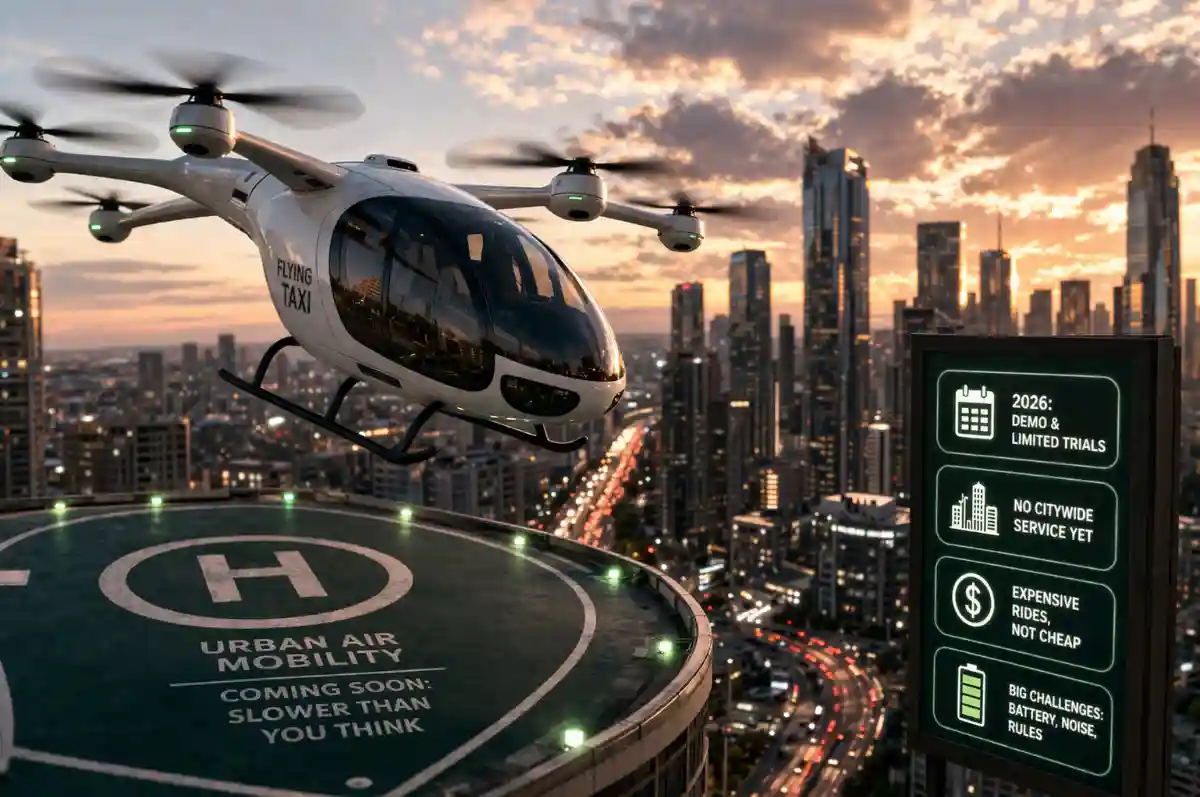
Flying taxis are starting to become a reality. Tech and aviation companies are starting to begin aerial taxi services in 2026. However, most of the general public will most likely not be able to access them, which leads one to ask, are they simply overhyping the tech?
The Rise of Flying Taxis (eVTOL Explained)
The technical term for Flying Taxis is eVTOL (electric vertical takeoff and landing) and they use electric propulsion. The current leaders of this new emerging market are Volocopter and Joby Aviation. These vehicles are able to take off and land like a helicopter, fly like an airplane, and use electric propulsion rather than fuel.
Therefore, eVTOL consists of more environmentally friendly and fuel-efficient transport.
The First Cities Getting Flying Taxis
When flying taxis are first introduced, they will only be launched in four specified cities. Those cities are Los Angeles, who recently made a tech investment, Paris, who is currently working towards smart mobility projects, and Dubai, who is already conducting tests on next-gen transport. As a precursor to the arrival of flying cars, the cities are building ‘vertiports’, which are aerial taxi landing pads on the roofs of buildings.
Flying Taxis: Why The Hype?
Flying taxis are not just pilotless cars that drive us to our destination. That is why people are searching for them. Benefits are explained below: No more traffic, as road congestion becomes irrelevant if we can fly. They are cleaner than cars because they are electric so they have no emissions. They also significantly reduce travel times, meaning no more waiting hours to get to your destination. With all these benefits it’s no wonder people are searching for them.

The Concerns
With all this new technology there are hurdles. Costs are high, as Flying taxis are starting to become a reality. Tech and aviation companies are starting to begin aerial taxi services in 2026 are going to cost more than standard taxis. Access is limited because in the beginning flying cars will only be available in select cities. Safety is another concern, including how traffic is going to be managed and what happens if there is a system failure. While there is a lot of excitement for flying taxis we should temper our excitement for these reasons.
Will there be AI taxi drivers?
Yes, but not anytime soon. Flying taxis are going to have human pilots for the foreseeable future. AI pilots are still a work in progress.
Reality vs Hype (The Truth)
Reality: Actual businesses are starting new services, tests are underway for new aircraft, and initial use approvals by governments are underway.
Hype: Not everyone can afford them, they won’t be accessible globally, and they are still in the early stages of development.
MAY 2026
Flying cars will come to fruition, but the services won’t be available to everyone. Like smartphones, they won’t be available everywhere, but will be the start of something revolutionary. The Flying cars will be the start of a new transport revolution, not the end of it.

Bottom Line
The concept of flying taxis is becoming a reality. But it will still take some years before they are a regular part of everyday journeys. Vertical take-off and landing flying carsare a disruptive emerging technology for solving urban mobility issues and traffic congestion.
eVTOLs do not pollute and customers can bypass road traffic. Flying taxis will also need to be integrated with new urban infrastructures, and regulatory considerations for safety and cost will remain. The challenges will be worth the benefit of offering the public advanced, sustainable mobility options that will lessen the burden of commuting.
